

It's the pain that sits deep in your lower back — but not quite in your lower back. It's off to one side, sometimes both. It aches when you've been sitting for a long time and feels sharp when you stand up, roll over in bed, or climb a flight of stairs. It might radiate into your hip, your glute, or down the back of your thigh in a way that makes people assume it's sciatica. It's not sciatica. It's not a disc. And if you've had imaging that came back unremarkable and you're still in pain, there's a reasonable chance nobody has looked closely enough at your sacroiliac joint.
SI joint dysfunction is one of the most underdiagnosed sources of lower back and hip pain we see at CORE Chiropractic's Greenway Plaza location at 3334 Richmond Avenue, Suite 107.
It is estimated to be the primary pain generator in somewhere between fifteen and thirty percent of all chronic lower back pain cases — yet it is frequently missed, frequently misattributed to disc problems or general muscle strain, and frequently left to become a chronic, limiting condition that affects everything from how you sit through a full workday to how you sleep at night.
If you have been living with unexplained lower back or hip pain and haven't had your SI joint properly evaluated, that evaluation starts here.
What Is the SI Joint and Why Does It Cause So Much Pain?

The sacroiliac joints — there are two of them, one on each side — connect the sacrum at the base of your spine to the iliac bones of your pelvis. They are large, weight-bearing joints that absorb and transfer the mechanical forces between your upper body and your legs with every step you take, every time you sit down, and every time you stand up. They are reinforced by some of the strongest ligaments in the human body, designed to be stable rather than highly mobile — which is precisely why problems in these joints are so difficult to identify and so persistent when they develop.
The SI joint moves very little under normal circumstances — typically just two to four millimeters of movement in any direction.
But that small range of motion is critical. When the joint becomes hypermobile — moving more than it should due to ligament laxity, injury, or hormonal changes — or hypomobile — restricted and stuck due to chronic postural loading, inflammation, or misalignment — the result is pain. And because the SI joint sits at the crossroads of the lumbar spine, the pelvis, and the hip, that pain can present in a remarkably wide range of locations and patterns.
The nerve supply to the SI joint is complex and extensive, which is why SI joint pain so frequently mimics other conditions. It can feel like a lumbar disc problem. It can feel like hip joint pathology. It can produce a radiating pain pattern down the leg that is nearly indistinguishable from sciatica at first glance. Accurate diagnosis requires a clinician who specifically tests for SI joint involvement — and treatment requires an approach targeted to the joint itself rather than the surrounding structures that are compensating for it.
Who Gets SI Joint Pain — and Why Desk Workers Are at Particular Risk
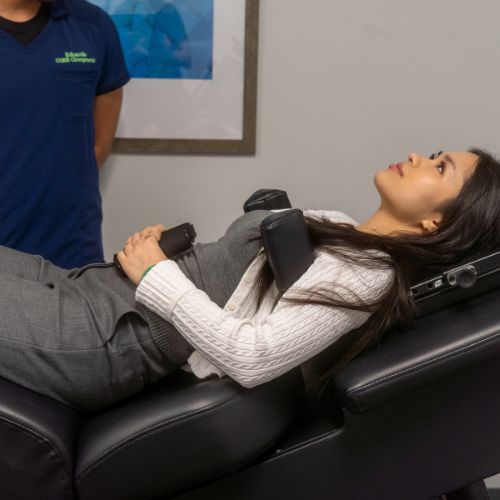
SI joint dysfunction does not discriminate by age or fitness level, but it does follow predictable patterns that track closely with how people use — and misuse — their bodies over time.
The professionals we see from the Greenway Plaza towers, the corporate offices along Richmond Avenue, and the firms throughout the 77046 and 77098 zip codes present with SI joint pain for a consistent set of reasons. Prolonged sitting is the primary driver. When you sit for hours at a time — particularly in chairs that don't support the natural curve of the lower back — the pelvis tilts posteriorly, the sacrum shifts, and the SI joints are placed under sustained asymmetrical loading. Do that day after day, year after year, and the cumulative effect on the joint mechanics is significant.
Leg crossing is another major contributor that is almost universal among desk workers. Habitually crossing one leg over the other introduces a rotational force into the pelvis that loads one SI joint asymmetrically while unloading the other — a pattern that over time creates the kind of joint restriction and compensatory muscle tension that drives SI joint dysfunction.
We also see SI joint pain frequently in patients from the residential neighborhoods surrounding the Greenway district — River Oaks, Montrose, Upper Kirby, and West University Place — whose symptoms are connected less to desk work and more to prior injuries, pregnancy-related ligament laxity that never fully resolved, or the accumulated asymmetrical loading of athletic activities and everyday movement patterns that have placed chronic stress on one side of the pelvis over many years.
Women are disproportionately affected by SI joint dysfunction across all of these presentations. The hormonal influences on ligament laxity — most pronounced during pregnancy but present throughout a woman's reproductive years — make the SI joint more vulnerable to hypermobility and the instability-driven pain that comes with it. This is not a condition that only affects pregnant or postpartum women, but it is a condition that affects women at significantly higher rates than men, and one that responds very well to the kind of stabilization-focused corrective care we provide.
How CORE Chiropractic Treats SI Joint Pain at Our Greenway Plaza Location
Every SI joint pain patient at CORE Chiropractic - Greenway Plaza begins with the same foundation — a thorough consultation, a detailed physical and orthopedic examination, and standing digital X-rays taken in our on-site imaging suite. The orthopedic examination for SI joint dysfunction includes a series of specific provocation tests designed to load the joint in ways that reproduce and localize the pain, confirming that the SI joint is the primary pain generator before we build a treatment plan around it.
This diagnostic precision matters because treating an SI joint problem like a lumbar disc problem — or vice versa — produces poor outcomes for the patient. The right treatment for the right diagnosis is the foundation of everything we do at CORE.
For most SI joint patients the treatment plan draws from the following:
Chiropractic Adjustments
Targeted, precise adjustments to the sacroiliac joint restore proper joint mechanics, address the restricted or hypermobile movement patterns that are generating the pain, and help the surrounding muscles release the compensatory tension they have been holding in response to joint dysfunction. SI joint adjustments are distinct from lumbar adjustments and require specific training and technique — our doctors are experienced in the presentation and treatment of sacroiliac dysfunction and adapt the approach based on whether the primary problem is restriction or instability.
Pelvic and Lumbar Stabilization
For patients whose SI joint pain is driven by hypermobility and ligament laxity rather than restriction, stabilization is the priority. This means targeted rehabilitation exercises designed to strengthen the muscles that support and control the pelvis — the gluteus medius, multifidus, and deep core stabilizers — reducing the demand on the ligaments and restoring the joint's ability to function with appropriate control. We prescribe these exercises specifically and progress them appropriately so they support rather than aggravate the joint.
PEMF Therapy
For patients with chronic SI joint pain — particularly those with significant inflammation, long-standing ligament irritation, or pain that has been present for months or years — PEMF therapy at our Greenway Plaza location provides targeted support at the cellular level. By reducing inflammation and supporting tissue healing in and around the joint, PEMF complements the mechanical corrections we are making with adjustments and rehabilitation, addressing the physiological environment of the joint rather than only its structural mechanics.
Spinal Decompression Therapy
For SI joint pain patients who also have a lumbar disc component — which is not uncommon given the mechanical relationship between the lumbar spine and the pelvis — spinal decompression therapy addresses the disc element of the presentation while the adjustments and rehabilitation address the sacroiliac joint directly. Many chronic lower back pain patients have both components present simultaneously, and treating only one while ignoring the other is a common reason why care plans produce incomplete results.
Postural Correction and Ergonomic Guidance
For the desk-working professional whose SI joint pain is being driven and perpetuated by prolonged sitting, addressing the joint without addressing the hours of daily loading that created the problem is an incomplete approach. We provide specific guidance on sitting posture, chair setup, movement habits throughout the workday, and the micro-corrections — like breaking the leg-crossing habit and using lumbar support correctly — that make a meaningful difference in SI joint health over time.
What to Expect at Your First SI Joint Pain Appointment
If you have been living with lower back and hip pain that has been attributed to various causes without a satisfying explanation or lasting improvement, coming to CORE Chiropractic Greenway Plaza for a SI joint evaluation is a straightforward, no-pressure process.
Your first appointment begins with a detailed consultation covering the full history of your pain — when it started, how it has evolved, what aggravates it, what provides temporary relief, what you have already tried, and any prior imaging or diagnoses you have received. We listen carefully because the history of SI joint pain often contains diagnostic clues that have been overlooked in previous evaluations.
From there we conduct a thorough physical and orthopedic examination that specifically tests for SI joint involvement using a standardized battery of provocation tests. We then take standing digital X-rays to evaluate the structural alignment of the pelvis and lumbar spine under load. The combination of the clinical examination findings and the weight-bearing imaging gives us the most complete and accurate picture available of what is actually driving your pain.
At your report of findings appointment — typically scheduled within one to two days — your doctor walks you through exactly what we found, explains the mechanics of your SI joint dysfunction in plain language, and presents a specific treatment plan with clear timelines and realistic expectations. You will leave that appointment knowing exactly what is causing your pain, what the plan is to address it, and what the investment looks like. We verify your insurance benefits before your first visit so there are no financial surprises.
Serving Greenway Plaza and the Surrounding Houston Neighborhoods
CORE Chiropractic's Greenway Plaza location at 3334 Richmond Avenue, Suite 107 serves one of the most professionally and residentially dense corridors in Houston. We are minutes from the main Greenway Plaza campus, easily accessible from the corporate towers throughout the 77046 zip code, and a short drive from the neighborhoods surrounding the district in every direction.
We see SI joint pain patients regularly from across the Greenway and Upper Kirby district — professionals working in and around the Greenway towers, residents of River Oaks, Montrose, West University Place, and Midtown, and patients from the neighborhoods between Buffalo Speedway, Shepherd Drive, Westheimer Road, and the Southwest Freeway. Our scheduling accommodates the demands of a full professional calendar — early appointments, efficient visit structures, and same-week availability for new patients who are ready to stop guessing at what's causing their pain and start doing something about it.
The neighborhoods we serve most frequently for SI joint pain treatment include Greenway Plaza, Upper Kirby, River Oaks, Montrose, West University Place, Midtown Houston, and the surrounding zip codes 77098 and 77046.
Frequently Asked Questions About SI Joint Pain Treatment in Greenway Plaza
How do I know if my lower back pain is coming from my SI joint or my lumbar discs?
The honest answer is that distinguishing between SI joint pain and lumbar disc pain reliably requires a clinical evaluation — self-diagnosis based on symptom location alone is notoriously unreliable for both conditions. That said, SI joint pain tends to be more localized to one side of the lower back just below the beltline, is often aggravated by transitional movements like standing up from a chair or rolling over in bed, and frequently produces a referral pattern into the hip and upper buttock rather than traveling all the way down the leg as classic sciatica does. The definitive answer comes from the orthopedic provocation testing we perform at your first visit.
Can SI joint pain go away on its own?
Mild, acute SI joint irritation — from a single incident of overloading or a brief period of unusual activity — can sometimes resolve on its own with rest and activity modification. Chronic SI joint dysfunction, particularly when it has been present for months or years and is associated with structural misalignment or significant ligament involvement, very rarely resolves without targeted treatment. Left unaddressed it tends to become progressively more limiting and is often accompanied by the development of compensatory problems in the lumbar spine, hip, and knee as the body adapts to protect the painful joint.
Is SI joint pain common during or after pregnancy?
Yes — it is one of the most common musculoskeletal complaints of pregnancy and the postpartum period. The hormone relaxin, which increases significantly during pregnancy to allow the pelvis to expand for childbirth, also reduces the stability of the SI joint ligaments. This can produce significant SI joint pain during pregnancy and, for many women, persists well into the postpartum period as ligament integrity takes time to fully restore. Chiropractic care for pregnancy-related and postpartum SI joint pain is safe, effective, and something we see and treat regularly at our Greenway Plaza location.
How long does it take to recover from SI joint dysfunction with chiropractic care?
Most patients with SI joint dysfunction begin to notice meaningful improvement within the first two to four weeks of consistent care. The full timeline depends on the severity of the dysfunction, how long it has been present, and whether there are contributing factors — ligament laxity, significant muscle imbalance, or concurrent lumbar disc involvement — that require additional time to address. We track your progress throughout your care plan with objective measurements and adjust the approach as needed so you always know where you stand and what comes next.
Do you accept insurance for SI joint treatment?
Yes. CORE Chiropractic - Greenway Plaza is in-network with Medicare, Blue Cross Blue Shield, Aetna, Humana, Cigna, UnitedHealthcare, and ASHN. We verify your benefits before your first appointment and walk you through exactly what is covered so you can make a fully informed decision without any financial uncertainty.
Your Lower Back Has Been Trying to Tell You Something.
If you have been living with lower back or hip pain that nobody has been able to explain satisfactorily — and you've had imaging that showed nothing remarkable while the pain continues — there is a real possibility your SI joint has never been properly evaluated. CORE Chiropractic Greenway Plaza has same-week appointments available, and your first visit includes a full consultation, orthopedic examination, and standing digital X-rays so you leave with real answers and a real plan.
We are right around the corner from Greenway Plaza. The pain you've been pushing through deserves a proper explanation.
3334 Richmond Avenue, #107, Houston, TX 77098 (713) 929-4330
Serving Greenway Plaza · Upper Kirby · River Oaks · Montrose · West University · Medical Center Houston