

Chiropractors use electrical stimulation, also called electrotherapy, to calm pain and muscle guarding so the rest of a visit can do its job. At CORE we reach for it when someone comes in hurting a lot, when an area is inflamed, or when a muscle is locked in a spasm that won’t let go. It sits alongside the adjustment, not in place of it.
What is chiropractic electrotherapy?
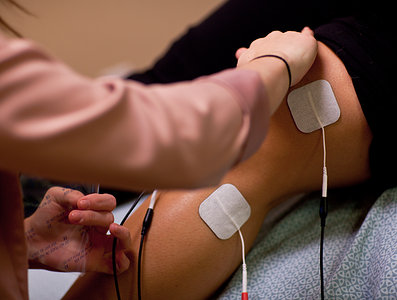
Chiropractic electrotherapy, or electrical stimulation, is a mild current passed through pads on the skin to stimulate the nerves and muscles underneath. You feel tingling or a rhythmic pulse. The two kinds most often used in an office are interferential current and premodulated current, which are close cousins of the TENS unit you can buy for home.
You’ll also hear it called e-stim or “the stim machine.” Both names describe the same thing: pads on the skin and a current set strong but comfortable.
It’s a different tool from the magnetic therapies we use. PEMF therapy and HEIT work through a magnetic field, with no pads and no current running across the skin.
When do we use electrical stimulation?
We use electrical stimulation when pain is high, when an area is inflamed, or when a muscle spasm won’t relax. In those moments an adjustment alone can be hard to tolerate. Calming the area first, or right after, often makes the visit more comfortable. It’s a support tool, used on the days and areas that call for it.
The first case is pain. When someone walks in bent over, a session under the pads first often makes it easier to get on the table at all.
Inflammation is the second. An area that’s hot and irritated after a strain or a fender bender on the 610 Loop is one we tend to treat gently, and stim is part of that gentle approach. If the crash is why you’re here, we explain why does my lower back hurt after a car accident in its own post, and what to do the night after a visit in heat or ice after chiropractic adjustment. In this case, we will add an ice pack during your electrical stimulation session.
Spasm is the third, and it’s the one patients notice most. A muscle that has clamped down to protect a joint can hold that grip for days. At a high enough setting, the current makes the muscle tighten and let go in rhythm. The idea is to break up the constant grip with that rhythm.
None of this replaces the adjustment. Before anyone adjusts you, we take standing x-rays and measure them, including the tilt and rotation of each vertebra. The doctor pulls up those x-ray notes before every adjustment. Electrical stimulation just makes it easier to do that work on a day when everything hurts. You can read more on our chiropractic x-rays page.
What is interferential therapy?
Interferential therapy, or IFC, runs two medium-frequency currents through four pads arranged in a square. The two currents sit a little apart in frequency, around 4,000 cycles a second, and they cross under the skin. Where they overlap, they interfere with each other and create a slower rhythm, called the beat frequency, that the nerves respond to.
The reasoning behind that design is comfort. Medium-frequency current passes through the skin with less of the prickle that a low-frequency current produces, so the idea is to get more current in before it becomes uncomfortable.
The long-standing claim is that crossing the currents puts the strongest effect deep in the tissue. A 2011 lab study measured voltage with needle electrodes in 12 healthy volunteers’ thighs. Voltage from both kinds of interferential current was highest in the skin and dropped with depth. With the four-pad setup, the strongest voltage actually showed up outside the square of pads, not in the middle where the currents cross. Even so, the authors concluded that four-pad interferential reached deeper tissue more efficiently than premodulated current.
What is premodulated therapy?
Premodulated therapy makes the same beat frequency inside the machine instead of under the skin. It sends one current that’s already rising and falling through two pads, so the rhythm is there the moment it reaches the body. Setup is simpler, and two pads are easy to place over one muscle.
Because there’s only one circuit, the current runs in a line between the two pads. In the 2011 needle study, premodulated current was strongest along that line.
Premodulated therapy is often called “two-pole” or bipolar interferential, and the name causes confusion. It’s still interferential current in the sense that it uses a medium-frequency carrier. The difference is where the beat is made.
What’s the difference between interferential and premodulated?
The main difference is where the beat frequency forms. Interferential crosses two currents through four pads so the beat forms inside the tissue. Premodulated builds the beat in the machine and sends it through two pads. The lab evidence on which reaches deeper is mixed, and neither setup has shown a clear edge in comfort.
A 2004 study ran volunteers through four setups, separating the crossing from the premodulation. Crossing the currents gave no advantage on a common stand-in for depth, the gap between the current you first feel and the current that makes a muscle contract. It also gave no advantage in contraction strength or comfort. Premodulated current also produced stronger contractions with less discomfort than steady, unmodulated current.
The 2011 needle study points the other way on depth. Its authors found four-pad interferential more efficient at reaching deeper tissue. Two small lab studies with different methods, two answers.
| Interferential (four-pad) | Premodulated (two-pad) | |
|---|---|---|
| Pads | 4, in a square | 2 |
| Where the beat forms | Under the skin, where the currents cross | Inside the machine |
| Area covered | Wider | A line between the pads |
| Lab findings on depth | Mixed: deeper in one study, no advantage in another | Mixed |
| Lab findings on comfort (2004 study) | Crossing the currents added no comfort | More comfortable than steady current |
TENS sends low-frequency pulses straight through the skin, usually from a small battery unit. Interferential and premodulated therapy use a medium-frequency carrier instead, which passes the skin more easily. In a lab test, changing TENS settings changed the response much more clearly than changing interferential settings did.
Those were lab studies on volunteers, not patients, so they tell you how the currents behave, not which one helps a sore back more. Nobody has run that head-to-head trial in patients that we could find.

How is interferential therapy different from TENS?
That second point comes from a 1999 study that stimulated the median nerve in 24 volunteers. Changing the frequency on TENS changed the sensory, motor and pain thresholds in a clear, predictable way. Changing the beat frequency on interferential barely moved them, and pure 4,000-cycle current with no beat at all did about the same as current with one. The researchers suggested that interferential’s medium-frequency carrier matters more than its beat, and that TENS was the more adjustable tool.
For pain, the two land close together. In people with chronic non-specific low back pain, a 2023 review found low-quality evidence that interferential current may have lowered pain a little more than TENS right after treatment, with no difference in disability.
For you, the practical difference is where you use them. A TENS unit goes home with you. Interferential and premodulated machines live in the office. If you’re considering a unit for home, we cover tens unit benefits in a separate post.
Does electrical stimulation work for back pain?
Trials found pain was lower during and right after electrical stimulation, and that short window is where the research is strongest. A 2023 review covered 13 trials and 1,367 people with chronic non-specific low back pain. Against placebo, interferential current probably reduced pain and disability right after treatment, but not at later follow-up.
TENS shows the same pattern. A 2022 review pooled 91 trials with 4,841 people comparing TENS with a placebo, across many kinds of pain. Pain was lower during or right after TENS.
The research we found measured pain, not inflammation or spasm. So we don’t present electrical stimulation as a treatment for either one. We use it to make an inflamed area or a spasming muscle easier to work with on the day, while the adjustments and your home exercises do the longer work. We show you the stretches and exercises to do at home, which saves you time and money.
That’s also why stim is something we use on some visits, not every visit. When the pain settles, the reason to use it usually goes away.
What does electrical stimulation feel like?
Electrical stimulation feels like tingling or a rhythmic pulse under the pads. At higher settings you may also feel the muscle gently tighten and release. We turn it up until it’s strong but comfortable, and you can tell us to turn it down at any point. It should never sting or burn.
Is electrical stimulation safe at the chiropractor?
For most adults it is. In the 2022 review, side effects were poorly reported but generally mild and no different from the comparison treatments. Tell us before your session if you have a pacemaker or any other implanted electrical device, so we can decide whether stim is right for you.
A note on where these numbers come from. The interferential and TENS comparison is from a 2023 review in the Brazilian Journal of Physical Therapy, Effectiveness of interferential current in patients with chronic non-specific low back pain: a systematic review with meta-analysis. The TENS findings are from Efficacy and safety of transcutaneous electrical nerve stimulation (TENS) for acute and chronic pain in adults: a systematic review and meta-analysis of 381 studies (the meta-TENS study), published in BMJ Open in 2022. The interferential versus premodulated comparison is A comparison of true and premodulated interferential currents, from Archives of Physical Medicine and Rehabilitation in 2004. The depth measurements are from Penetration and spread of interferential current in cutaneous, subcutaneous and muscle tissues, published in Physiotherapy in 2011. The frequency study is Alteration of interferential current and transcutaneous electrical nerve stimulation frequency: effects on nerve excitation, from Archives of Physical Medicine and Rehabilitation in 1999.